
💡这项突破是什么?
南湖新闻网讯(通讯员 叶静)近日,动物科学技术学院、动物医学院、农业微生物资源发掘与利用全国重点实验室曹胜波教授、叶静教授研究团队历经八年持续攻关,在正黄病毒宿主防御机制研究领域取得重要突破,研究成果以“A CRISPR activation screen identifies SPART as a pan-orthoflavivirus restriction factor”为题在Cell Host & Microbe发表。研究首次揭示 SPART(SPG20)是靶向寨卡、登革、乙脑、西尼罗等多种正黄病毒的广谱宿主限制因子,阐明其通过调控 E3 泛素连接酶 ITCH、阻断病毒衣壳泛素化与脱壳的核心分子机制,以及在决定病毒组织嗜性中的重要作用,为广谱抗正黄病毒药物研发提供全新靶点与重要理论支撑。
正黄病毒包括寨卡、登革、乙脑、西尼罗病毒等,主要通过蚊虫传播,可引发脑炎、出血热、胎儿畸形等重症,全球尚无特效药物,防控形势严峻。宿主限制因子是机体抵御病毒感染的天然屏障,筛选广谱抗正黄病毒宿主因子、解析其作用机制,是开发广谱抗病毒策略的关键。
团队利用全基因组 CRISPR 激活筛选技术,在人绒毛膜癌细胞模型中成功筛选并鉴定出广谱抗正黄病毒宿主因子 SPART。研究证实,SPART 可高效抑制寨卡、登革、乙脑、西尼罗病毒感染,但对甲病毒、疱疹病毒、冠状病毒无作用,具有高度病毒特异性。
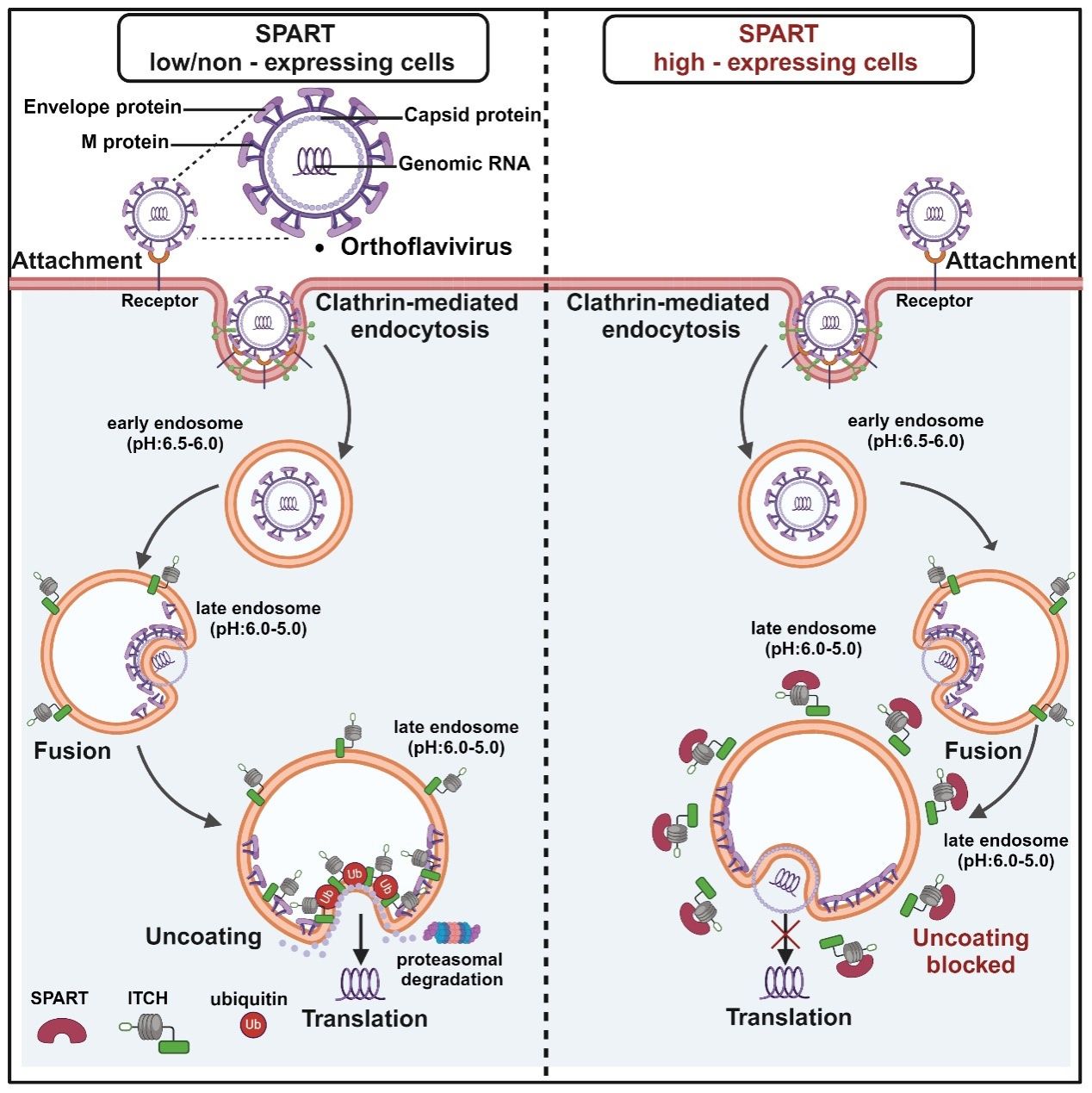
SPART限制正黄病毒脱壳分子机制模式图
机制研究揭示了一条全新抗病毒通路:SPART 通过直接结合并锚定 E3 泛素连接酶 ITCH,阻止 ITCH 向晚期内体转运;正常情况下,ITCH 可催化病毒衣壳蛋白 K5/K6 位点泛素化、触发衣壳降解与基因组释放,是病毒脱壳的关键促感染因子。SPART 通过劫持ITCH,阻断衣壳泛素化,将病毒基因组 “锁死” 在内体中,从源头阻断感染进程。体内实验进一步验证,Spg20 敲除小鼠对寨卡、乙脑病毒高度易感,而 Itch 敲除小鼠表现出显著抗病毒能力,充分证实 SPART-ITCH 轴在正黄病毒感染、组织嗜性中的决定性作用。
该研究首次发现 SPART 为广谱抗正黄病毒宿主因子,阐明宿主通过调控病毒脱壳实现广谱防御的全新机制,为广谱抗黄病毒药物开发、基因编辑抗病模型构建提供精准靶点与科学依据,具有重要理论价值与转化前景。
华中农业大学动物科学技术学院、动物医学院博士研究生李琦为论文第一作者,叶静教授、曹胜波教授与美国华盛顿大学 Michael S. Diamond 教授为共同通讯作者。研究得到国家自然科学基金、国家重点研发计划等项目资助。
【英文摘要】
Orthoflaviviruses, including Zika (ZIKV), dengue, Japanese encephalitis, and West Nile viruses, cause diverse clinical syndromes and threaten human health. Identifying factors that inhibit orthoflavivirus infection could lead to antiviral countermeasures. Here, we conducted a genome-wide CRISPR activation screen and identified the host gene SPART (Spartin/SPG20) as a restriction factor against ZIKV and other orthoflaviviruses. SPART interacts with and disrupts the endosomal localization of Itchy E3-ubiquitin ligase (ITCH), which we determine ubiquitinates the ZIKV capsid, thereby triggering uncoating. Loss of SPART enhances ZIKV replication, an effect not observed in SPART-ITCH double knockout mutants. Maternal ZIKV infection of Spg20−/− mice results in heightened maternal and fetal viral loads and greater fetal abnormalities, whereas infection of Itch−/− mice yields opposite outcomes. Similar results were observed in these gene-edited mice upon infection with related orthoflaviviruses. Overall, this approach identified a broad orthoflavivirus restriction factor, providing a potential target against these emerging pathogenic viruses.
论文链接:https://www.cell.com/cell-host-microbe/fulltext/S1931-3128(26)00174-5
审核人:曹胜波